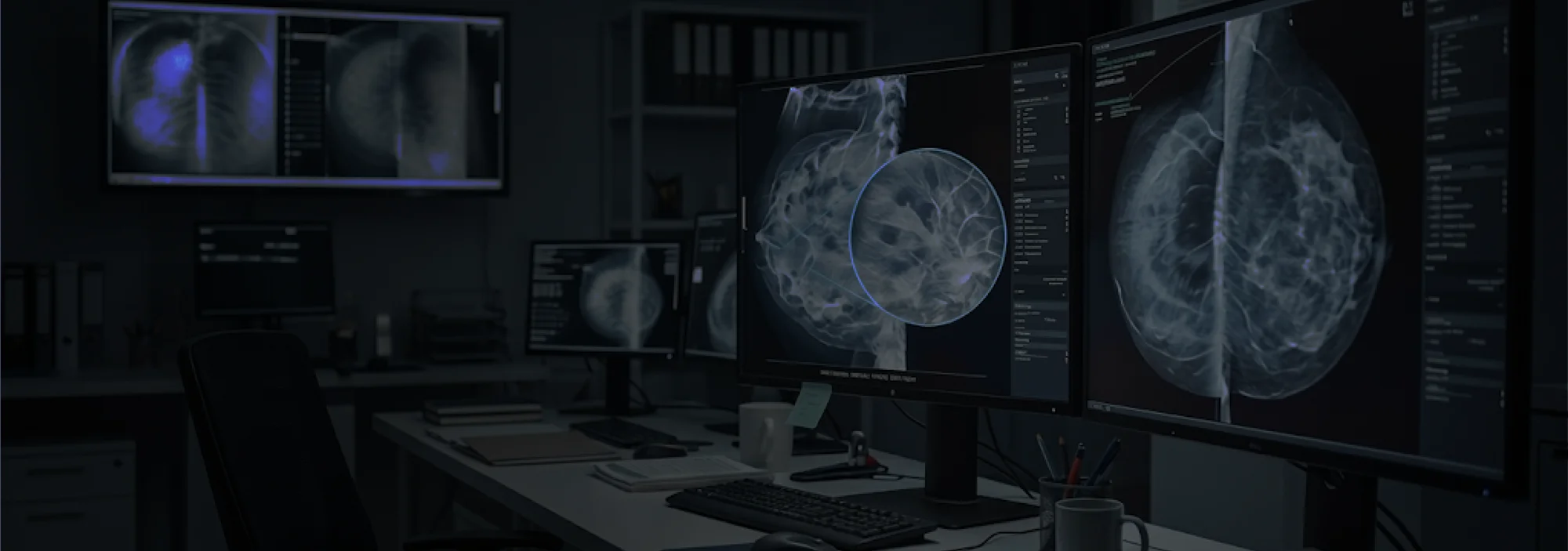
Human–AI Disagreement in Breast Screening
When AI and a radiologist reach different conclusions in NHS breast screening, accuracy alone cannot determine how responsibility should be shared. Our resulting service, Ready-ology, structures disagreement as support for decision-making, accountability and shared learning — without replacing clinical judgement.
- Role
- Service Designer, Researcher & Prototype Designer
- Team
- Three-person RCA team
- Timeline
- March–July 2026 · Five months
- Outcome
- Governance framework and interactive service prototype
My contribution
My contribution spanned the project from research synthesis and service design to interaction design and a functional front-end prototype.
- Research
Expert input and stakeholder mapping; turned a teammate’s nine workflow examples into four AI-placement patterns.
- Service design
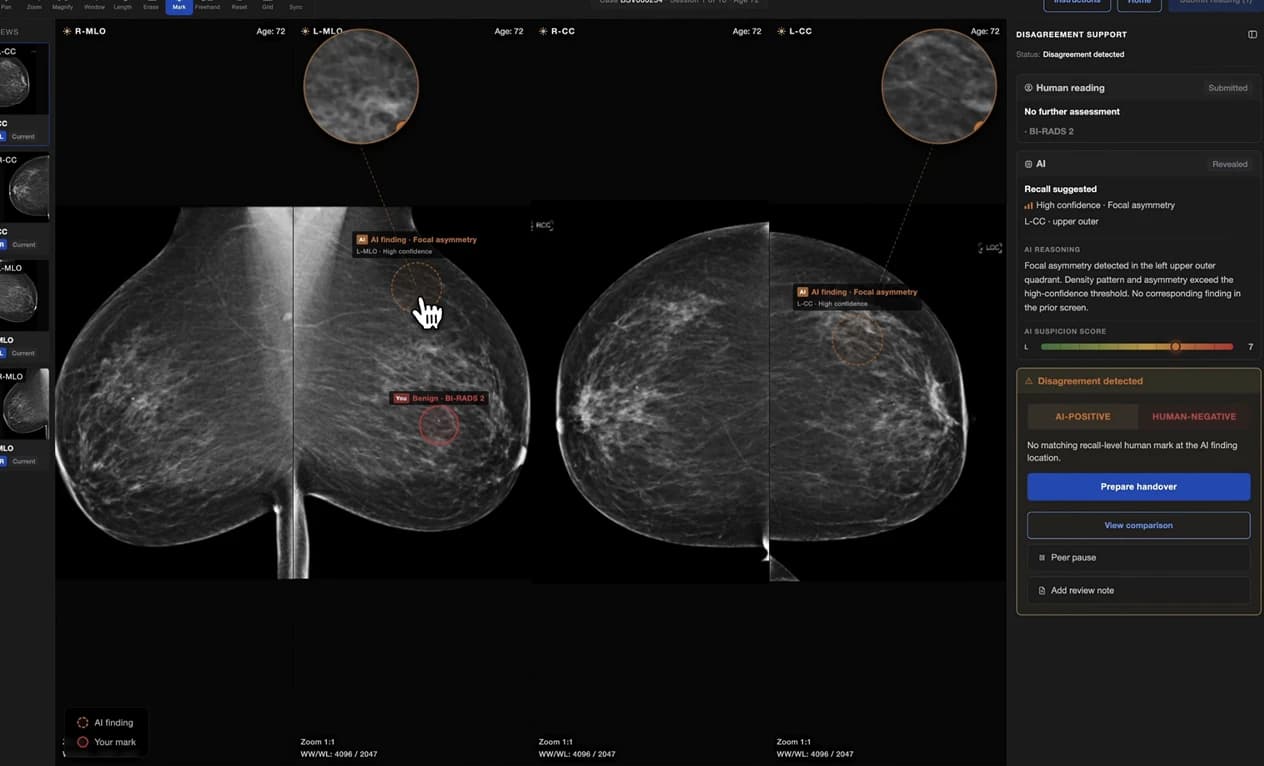
Translated the disagreement gap into a three-layer service journey and designed the Reading View interaction.
- Prototype build
Designed and built the functional Reading View prototype in HTML, CSS, and JavaScript.
Project brief
NHS breast screening relies on independent double reading: every mammogram is assessed by two radiologists, and disagreements go to arbitration before the final recall decision.
AI is now entering this workflow as a possible second reader. But when AI and the radiologist reach different conclusions, the workflow does not clearly define how that disagreement should be recognised, reviewed, recorded, or learned from.
Ready-ology responds to that gap by structuring the disagreement moment without adding unnecessary friction to an already pressured clinical workflow.
Design focus
Most conversations about AI in breast screening focus on how accurate the model is. We were more interested in something more human: how people and AI work together — especially in the moments they disagree.
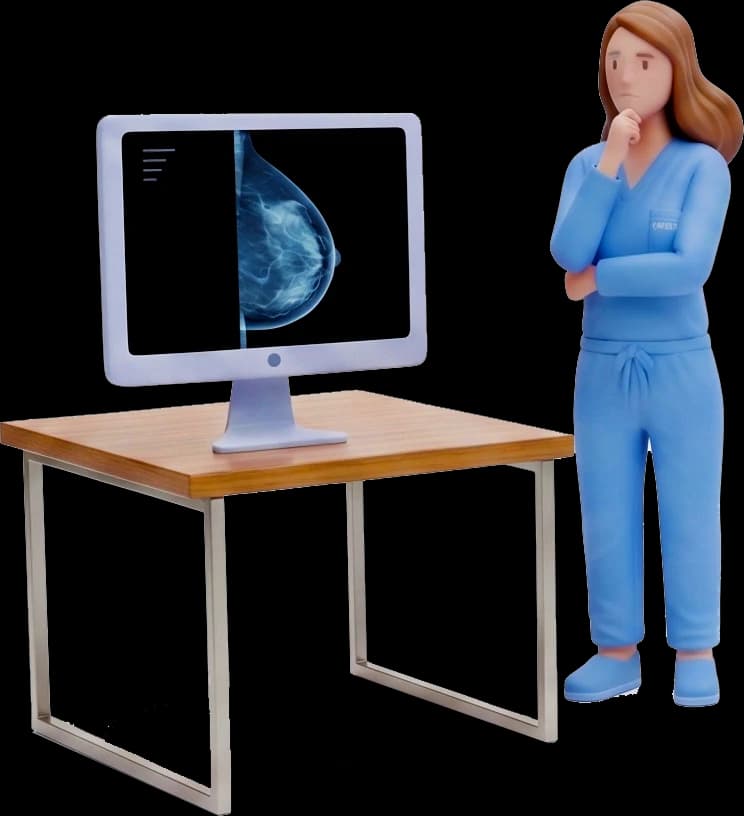
Typical AI focus
Can AI detect cancer accurately?

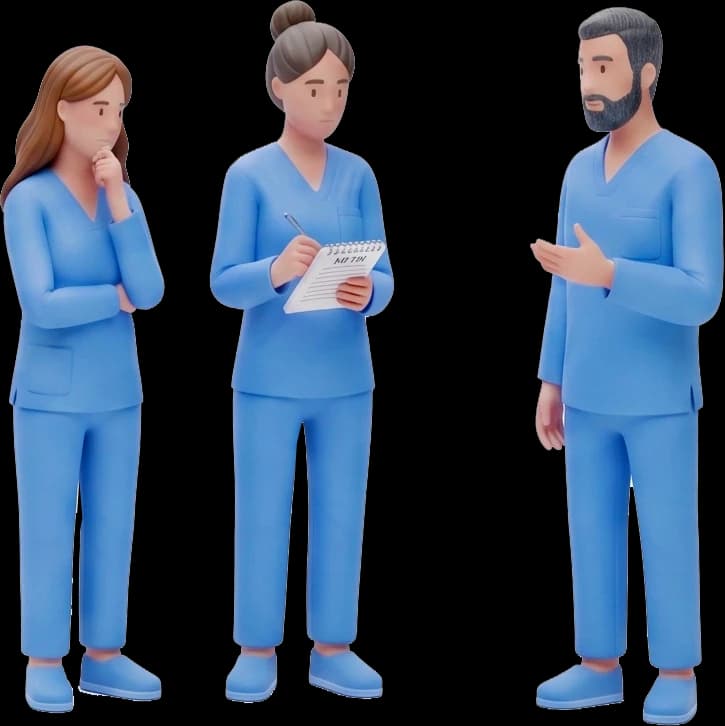
Our design focus
How should AI and radiologists work through disagreement?
Research at a glance
- Understand the system
Desk research · workflow mapping · stakeholder mapping · precedent review
- Understand the people
Expert consultations · public interviews · online ethnography · human factors analysis
- Test the service
Prototype testing · expert feedback · thematic analysis
Service overview
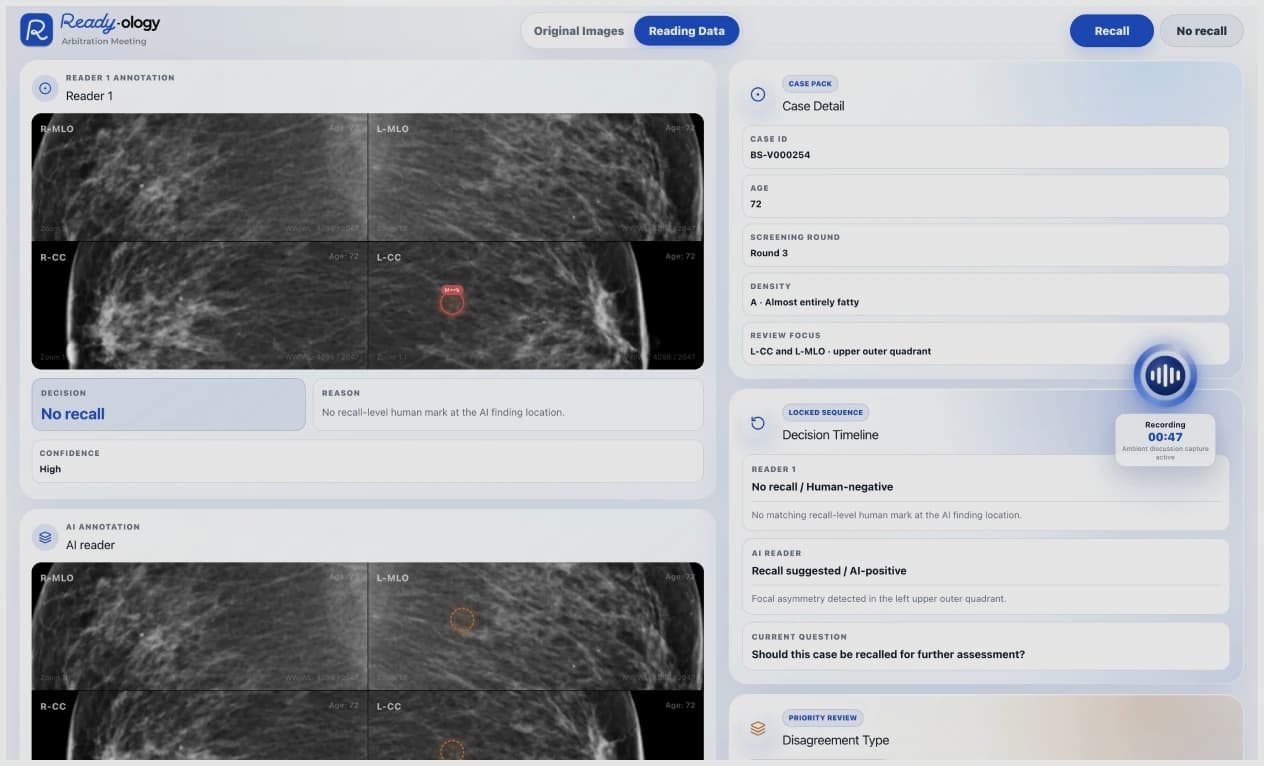
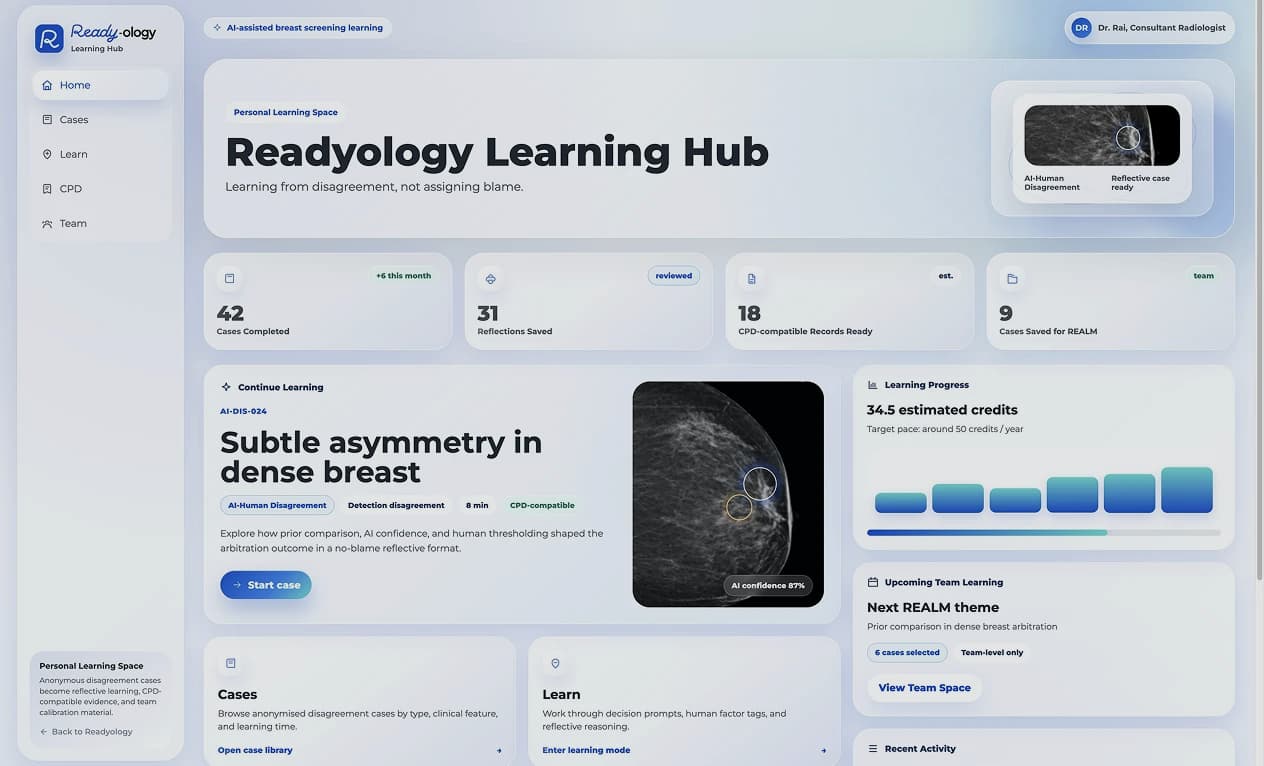
Ready-ology sits alongside the existing radiology workflow — it does not replace clinical judgement, it structures the moments around it.
These are not three separate screens — they are three connected interventions across one disagreement journey: recognising and structuring the disagreement as it happens, reviewing evidence and reasoning together in arbitration, and turning the hardest cases into learning and governance records afterward.
Validation
Expert feedback validated the service logic, clinical language, and arbitration structure — including one constraint repeated in nearly every session: "keep it simple, no extra steps for the radiologist." A second usability session tested layout, information hierarchy, tone, and cognitive load.
The biggest shift was moving away from a physical toolkit. Radiologists already work under high cognitive pressure, so the service became a lightweight digital layer embedded in the existing workflow.
Round 1 — Service logic. Expert review session with Prof Sophia Zackrisson: clinical language, arbitration structure, and disagreement framing tested against a live clinical scenario.
Round 2 — Interface usability. The Reading View interface tested for layout, information hierarchy, tone, and cognitive load under simulated time pressure.
Exhibition
The prototype was shown at the RCA final exhibition, where conversations with visitors — including a practising radiologist — tested how the proposal held up outside the research that shaped it.
One reaction stood out: the proposal still felt too idealised for real clinical practice. That was a fair critique — the service had been developed mainly through research, interviews, and structured feedback, not through co-design inside radiologists' everyday working environment. The next iteration needs to be built with practitioners in situ, not just validated after the fact.
Ready-ology presented as a working prototype, service journey, and supporting artefacts at the RCA 2026 degree show.
A practising radiologist reviewed the proposal and discussed its limits for direct clinical practice.
Contribution & reflection
Contribution. The hard part was never the interface itself — it was translating a research finding into a working clinical interaction: deciding what information appears, when, and why, so the radiologist's authority is supported rather than quietly displaced by the AI. That meant designing an information hierarchy that reduces cognitive burden at a high-pressure moment, while still surfacing disagreement clearly enough to act on — support for judgement, not a replacement for it.
Reflection. This project changed how I think about designing with AI in professional practice — not toward making AI feel more trustworthy, but toward making the radiologist’s own judgement easier to see and record when AI is involved. It also made clearer something I kept meeting during the year: the hardest problems in AI, healthcare, and governance can't be solved by design alone. Design's role here was to create the conditions for better judgement and collaboration — support, not replacement — and, as the exhibition made clear, designing with the people who would use it, not only for them.